

Aristotle and The Unicorn of Time at FUSION
NEWS | TUESDAY, JULY 21 | BY FUSION STAFF WRITER, RUDOLFO CARRILLO
Question: What sounds like the title of a particularly esoteric Tom Robbins novel or an essay by Jacques Derrida but instead portends a deep yet totally accessible discussion into the very nature of the perceptual experiences of all human beings?
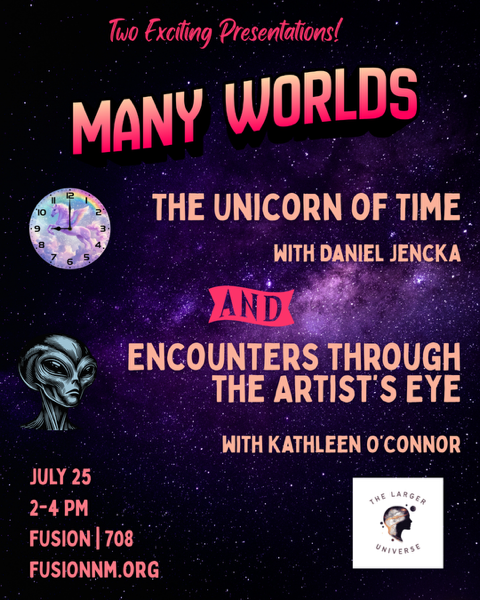
Answer: Daniel Jencka’s upcoming presentation about the nature of time to be held at FUSION as part of the Many Worlds event, organized by The Larger Universe, on Saturday, July 25 at 2:00 PM.
The discourse that Jencka will offer the FUSION community focuses on his contention that the Greek philosopher Aristotle gave significantly prescient and accurate life to theories about time—theories that postmodern humans might find to be a radical departure from what they have always assumed, vastly different from what they learned through both lived experience and their acceptance of modern science.
Yes, it’s going to be an esoteric and engaging event, and Jencka’s work requires both an engaged mind and room within that mind for discerning the big picture (the universe around us). But stretching the brain to think about—to wonder about, to snatch up and challenge the muse of the imagination that resides at the heart of the matter as we consider “many worlds”—is also something that can be vastly enjoyable and infinitely fun.
I got a hint of the very serious, mixed masterly together with the amazingly, humanly whimsical, when I spoke to Jencka about his work, his beliefs, and how time may be an illusion that we have trained ourselves to believe in as we move through life and through the limitless universe looking for meaning.
While our conversation zigged and zagged through many different philosophical and historical contexts, one thing came clear: Daniel Jencka is an expert on the subject matter he will be presenting at FUSION this weekend. An adept speaker and conversationalist, his ideas shine brightly as he discourses about them. The implications of that mastery of subject matter is certainly important for the FUSION community, for readers, for audience members, for anyone interested in thought-provoking cultural encounters.
Rudolfo Carrillo: I’d like to talk to you today about your presentation at FUSION on the 25th. It’s entitled Aristotle and the Unicorn of Time, which sounds intriguing.
Daniel Jencka. Sure. It’s a long enough presentation that I hope that I get across to people that Aristotle had a unique solution to questions about time. The unicorn part is important of course; for the Greeks, the unicorn was a real creature. Later on, by the time we got to the Middle Ages, the unicorn had become a fully mythical creature with their horn in the center of the head; sometimes unicorns could fly, and parts of their bodies had magical properties. The idea behind the title of my talk, and I think the best part of the presentation, may be in the discussion afterwards. That discussion has to do with Aristotle having developed a complete theory of time.
What did Aristotle believe about time?
He’s actually known as the only philosopher or scientist who developed a complete theory of time that related to the entirety of the rest of his [philosophical] framework. He was empirical about matters of the soul. Here’s his idea in a nutshell: Aristotle’s metaphysics, his physics, everything about Aristotle was an alternative to Plato. Aristotle dismissed the idea that there were these perfect forms and that we lived in a world of imperfect imitations. Aristotle said that the forms of things are the things [themselves].
Whoa, that’s heavy stuff. How does that philosophical proposition relate to the human perception of time? Does Aristotle hint that things in the physical world are imbued, as forms, with potentiality? Is that where we get our perception of time?
Potentiality comes before and after the now.
That sounds sort of enigmatic. How do you plan to decipher such complex concepts for the audience at your presentation?
People should come to this presentation because they have never been exposed to ideas that are so radical yet so familiar that they make so much sense today, now. This information is well over 2,000 years old and has been forgotten about except by some Aristotle scholars. That makes our event a unique event as well as a unique opportunity to explore the larger universe.
I know there’s time for that sort of exploration at FUSION, but you still haven’t revealed the nature of time, que no?
Here’s a teaser about his actual theory of time: Time is a relationship; time is a relationship between our consciousness and change. Outside of the relationship, it does not exist, time has no existence. Only things moving, in motion, and change are real; our souls and consciousness are real. Time is part of the relationship. This poses huge challenges to modern physics. But the challenge that I make, and Aristotle makes, is that we are wrong about time. We are missing the boat because we are chasing unicorns.
Daniel Jencka grew up in Michigan where he earned a BS in philosophy and early music performance practice at Oakland University. As a harpsichordist he performed in many professional concerts and recitals, and later entered graduate school at Indiana University to pursue a PhD in philosophy. Life took many turns, and he ended up leaving academia, but he never left the paths of music and philosophy. Today he divides his time between working in the solar industry, playing the harpsichord, reading philosophy, and exploring the larger universe with his wife, The Larger Universe founder Birdie Jaworski.
The Larger Universe presents Many Worlds Presentations
Saturday, July 25, 2026
2:00 PM 4:00 PM
FUSION | 708
708 1st Street Northwest
Albuquerque, NM, 87102
Free RSVP Here.