

Good Grief
NEWS | TUESDAY, JULY 7 | BY FUSION STAFF WRITER, RUDOLFO CARRILLO
If you live on Earth, then you have experienced grief. It’s that simple, though the process itself can be difficult, a series of trying moments and experiences within the framework of life. Making such experiences meaningful against a backdrop where everything is constantly changing can be a challenge, best dealt with in a community that honors the experience of grief while providing a pathway for emotional and spiritual connection and healing.
There is a profound sense of humanity present in the gatherings and rituals that result from these transcendent processes, and FUSION may be the place where such opportunities become brightly visible, bridging the gap from our world to yours.
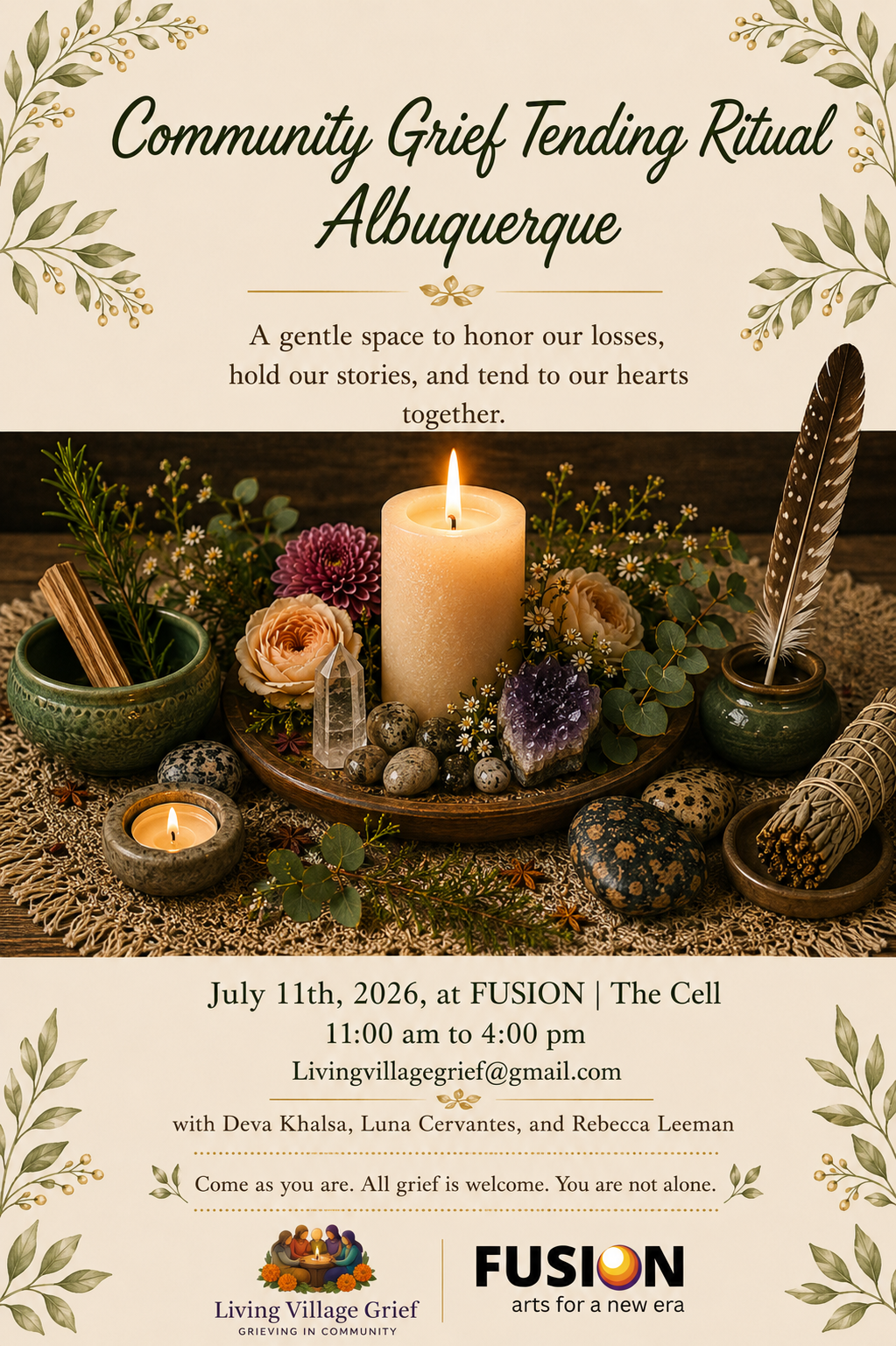
FUSION will host a Community Grief Tending Ritual, led by practitioners and guides from Living Village Grief, on Saturday, July 11, from 11 AM to 4 PM. This grief tending ritual will be facilitated by Luna Cervantes, Deva Khalsa, and Rebecca Leeman; it’s an important event that all humans should consider attending. Grief is a universal force in this life, and the workshop aims to get to the heart of the matter.
To find out more about the process of grief and the workshop at FUSION this weekend that is meant to reckon with such a powerfully intense set of experiences and circumstances, we sat down with grief facilitator Rebecca Leeman to discuss loss and life itself.
Rudolfo Carrillo: I’d like to know more about your event. Can you please tell me about your event at FUSION, the Community Grief Tending Ritual?
Rebecca Leeman: First, I want to mention the origin of this kind of work. There’s a psychotherapist in California named Francis Weller, and he’s been leading community grief rituals for about thirty years in his community. He wrote a book called The Wild Edge of Sorrow. He also came up with a book called In the Absence of the Ordinary. We live in a grief-avoidant culture, and on that premise, and in Weller’s writing, there’s been a call over the years to learn how to facilitate grief work in groups, so that we can touch on our own personal grief, and also knowing that others share some of the same things we feel when grieving
How is our culture “grief-avoidant”?
We haven’t been very used to gathering and discussing what sometimes becomes very isolating when we have grief. We’ve all been told that you’re supposed to get over it in a year, so [ongoing] grief becomes something that we keep in the shadows.
How does your work challenge avoidance and isolation?
Grief can be very intense sometimes, especially if it hasn’t been allowed to surface. We provide a variety of exercises, like singing and writing and dance or authentic movement, a variety of ways to process grief in a group environment.
Would you please walk me through the ritual you envision happening this weekend at FUSION?
There will be three people, three grief facilitators, at the event, one of whom is a yoga instructor, Deva Khalsa. Luna Cervantes is an ecstatic dance facilitator. I really think that what they are doing is dance and movement therapy; this helps create a healing, therapeutic space. But really, anything goes, you can cry in a corner if you want to, or be real quiet, or you can interact. So there’s a lot of freedom of emotional expression. And then I come from... I was a nurse midwife for 35 years, just retired. I also had a very big loss. I had a suicide loss of my oldest son about eleven years ago. So I feel like I’m ready to give back now, from what I have learned in intense grief.
We call [those interactions and rituals] grief tending. We’re taking the wisdom of Francis Weller to say that it's really important to grieve. And it may not be for everybody, but to grieve in a context of community is an important step forward and through grief.
Why do you think people in our culture choose to grieve singularly or keep to themselves as opposed to participating in a larger, supportive community?
It’s certainly not baked into our culture to do so. I think there are things like wakes and funerals, things that come early on, but I think there is a real sort of cultural drive that people are trying to adapt to that says “get over it,” or an ingrained urge to not let it go on so long. I think one thing we really need is to step back.
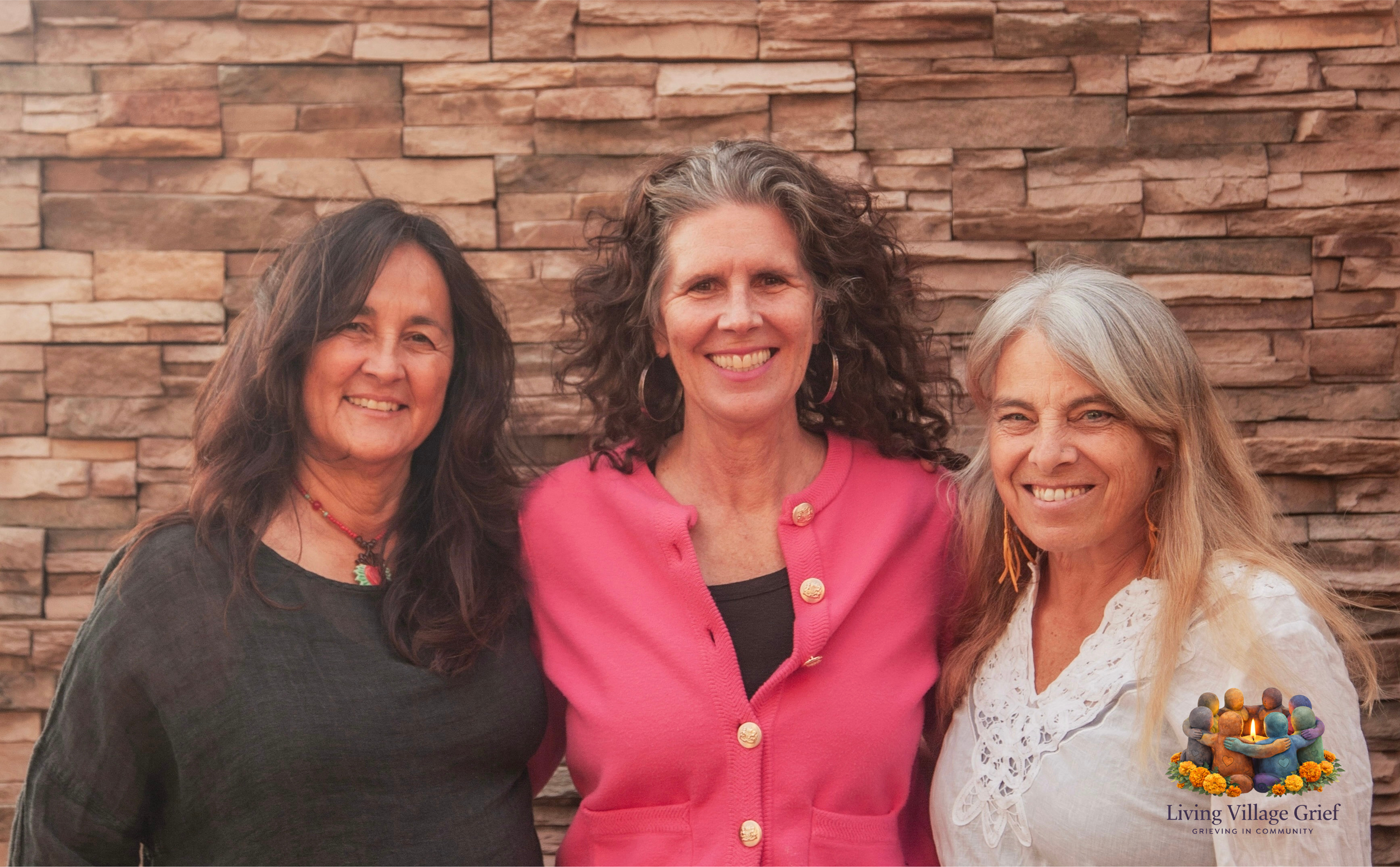
FACILITATORS LUNA CERVANTES, DEVA KHALSA, REBECCA LEEMAN
I’ve read that stepping back means acknowledging and understanding different types of grief. Can you please comment on that?
Francis Weller talks about different gates of grief. So everyone that you love, everyone you will lose is the first gate of grief; in his writings, that could involve a relationship or it could be something significant, but usually about a person. Another gate of grief involves the parts of us that have not known love; like the parts of us that we’re ashamed of and we put away somewhere. In our grief rituals, all grief is welcome. We’re not trying to say we’re only going to talk about this kind of grief, but that one is a big one. It's not expected sometimes that people feel sad for the parts of them that they've shut away. The third gate of grief is environmental grief, the ‘sorrows of the world’ is what Weller calls it. That’s really big. We don’t get to talk about that much, like the impact of the dying off of different species or fear of nuclear annihilation. This is another thing that informs us at our grief tending rituals. Another gate of grief is loss of the village; the fifth one is ancestral grief.
Why should people out there in the world come inside, into your community to better experience and process grief?
I think it’s the chance to be involved in an enriching, healing community grief ritual. It’s the chance to share, in a relatively small group, things that you’ve been thinking deeply about; maybe it’s been in your heart—that feeling that you wanted to talk about your experiences with grief. We let people speak, and basically the group listens and says thank you. So it’s really a place where people can thrive…maybe they just want to be heard, and perhaps if they don’t feel ready to speak, they’re still getting a lot from hearing other people sit in a circle and share. I think a person that would really benefit is somebody who wants to not feel quite so alone. In that way, we are sensitive to what we feel the needs of our community are.
Community Grief Tending Ritual by Living Village Grief
Saturday, July 11, 2026
11:00 AM - 4:00 PM
FUSION | The Cell
700 1st Street SouthwestAlbuquerque, NM, 87102