

NEWS | FRIDAY, MAY 22 | BY FUSION STAFF WRITER, RUDOLFO CARRILLO
When you hear or read the word sanctuary, what ideas come to mind? If you’re like me, deeply ensconced in the forms and symbols of the humans with whom I share this fragile Earth, you might think of a place that’s safe, a shelter from the onslaught of cultural oppression and marginalization that affect the inner self as well as the world outside of me.
More importantly, you might view sanctuary as a place where you can be authentic. In that case sanctuary is a place where that identity and the shared community you are part of gives you the authority to tell your own stories, define your own history, and create your own beautiful human image of yourself, that community, and hopefully, maybe at last, the world.
The above view of the world demonstrates a potent form of cultural resistance, a system of uplift that is designed to defy the norm, build new communities, and usher in a peaceful, inclusive, and hopeful American culture; the operative concept here is called narrative sovereignty.
One of Albuquerque’s biggest contributors to the dialogue I wrote about above is Sanctuary Cinema. According to the interwebz, Sanctuary Cinema is “a New Mexico–based film and community dialogue project dedicated to creating brave spaces for belonging, reflection, and transformative justice through documentary film.”
Talk about “Shelter from the Storm,” here’s the real deal!
Sanctuary Cinema, a community-based movement founded by shiloh burton and Luis Peña-Álvarez, is a vibrant part of the Albuquerque arts and film community. As I found out, the really cool thing is that Sanctuary Cinema is in residence at FUSION. Their next screening is at FUSION on Thursday, June 18, beginning at 5:30 PM.
To find out more, I sat down with Burton and Peña-Álvarez. Here’s a look into our expansive conversation about film, sanctuary, narrative sovereignty, and the fusion of those positively necessary ideas and actions.
Rudolfo Carrillo: Can we talk about the films that are at the heart of Sanctuary Cinema?
shiloh burton: We curate the films based on what’s going on. So we’re really thinking about the issues that New Mexico and the nation are facing…and what are the people in our community doing about those issues. One of the things that Luis and I think is important is to break up these [cultural] silos. You have government organizations over here, you have artists over here, you have the film industry and filmmakers over here, and non-profits over here…and people weren’t talking to each other, even though they were working on similar issues. That’s the nature of capitalism, that's the nature of the speed-up, it’s the nature of being busy; it’s all those things. So we provide an opportunity to host community conversations across differences to bring people together to build a community of practice [that will address those issues]. The idea is that people will come to see about an issue and see the solutions, see the work others are doing, and see where they might fit.
What are some of the ways they can fit into finding solutions to the issues Sanctuary Cinema takes up?
Whether it involves donating to one of the non-profits that are represented on our panels, donating directly to FUSION, volunteering, helping with our education efforts; we just screened The Librarians recently and talked about how legislation goes through, how books get banned.
What’s your curation process like?
For every month we curate, we start with the PBS POV [Point of View] catalog; we also have many friends who are independent filmmakers. We also include their works in our selection process. If I had to put it into one sentence, I’d say it’s all about narrative sovereignty.
What does narrative sovereignty mean to you all at Sanctuary Cinema?
There’s a lot of misinformation and stereotyping and oppression right now. There’s really horrible fake news being reported on out there. We are only interested in showing films where the person behind the camera and the person in front of the camera have a shared life experience, so the story is being told authentically, fully, in all of its dimensions. The colonial, anthropological view of outsiders “coming in and studying the natives,” we’re not doing that! We’re not showing documentaries by people that are outsiders to the lives they document. Lived experience and hearing directly from the source are the number one factors in us deciding on which films to screen.
Hmm, that reminds me of Louis Gates’s films… Walk me through one of your screenings!
So, if we have the budget, we have free food. When we get sponsorship from organizations like PBS, Explora, or the W. K. Kellogg Foundation, we’ll provide food for about half an hour and then screen an excerpt or excerpts from the feature film or short film chosen for that week. It varies. Sometimes we’ll screen three different excerpts…the different partners we work with have different stipulations. We screen for about 45 minutes to an hour and then introduce the panel. Luis and I take turns emceeing and we ask them one or two questions before opening up the discussion to the audience. It becomes a natural community conversation. That takes up about 45 minutes before we beg the audience to fill out our survey.
What has the community response been like?
Luis Peña-Álvarez: We’ve actually just marked a year. Within a year we’ve been able to partner with NM PBS, with Explora and through them, with the W. K. Kellogg Foundation; their initiative is based on racial healing. That sort of partnership is something that we are really excited about. Our work has blossomed into more conversations about many things! The response that we’ve gotten…we wouldn’t have been able to interact with all those amazing partners if we’d hadn’t had such a positive response to begin with. We’ve heard that people in Albuquerque really value this sort of interdisciplinary conversation.
How would you all like to grow in the coming years?
Obviously, what we wish for in terms of a bigger audience would probably involve younger people. And that’s why we really started this, because we saw the younger people here in Albuquerque and they needed a place to congregate, to discuss what’s going on…and film is a popular medium everybody watches films, everybody talks about films. The great aspect about documentary film is that you can find stories by the people, about the people. With Sanctuary Cinema, we hope to give back, to give that aspect, those films, back to the community, especially to the youth. We’re excited about the future conversations our project will create.
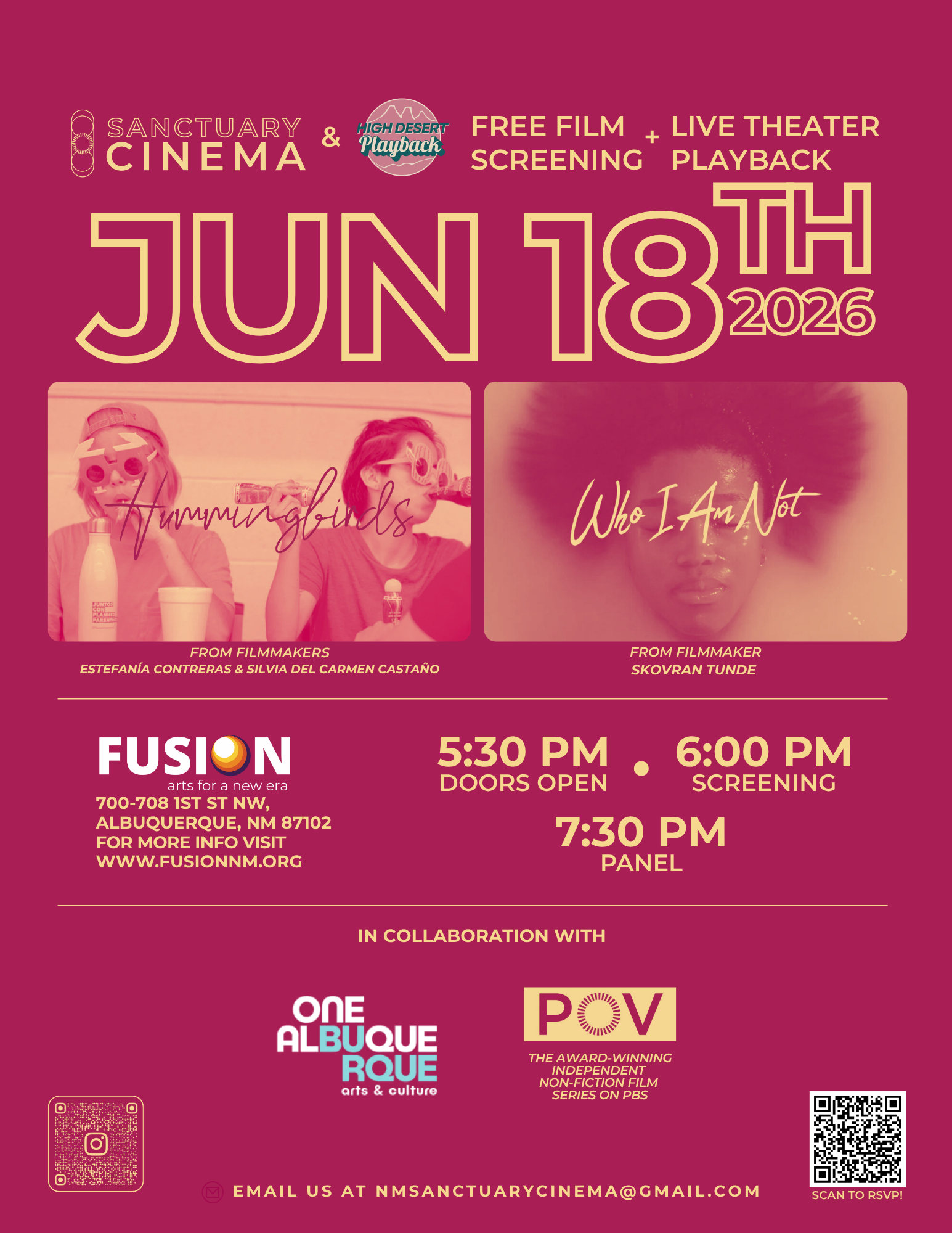
Join Sanctuary Cinema, in collaboration with the City of Albuquerque, and High Desert Playback for a community film screening of HUMMINGBIRDS and WHO I AM NOT on Thursday, June 18, at 5:30 PM. This special screening includes High Desert Playback as the panel. HDP will be playing back the stories from the audience.
Sanctuary Cinema, High Desert Playback & CABQ One present HUMMINGBIRDS + WHO I AM NOT
Thursday, June 18, 2026
5:30 PM 8:30 PM
FUSION
700-708 1st Street Northwest Albuquerque, NM, 87102
Free RSVP Here.
SUPPORT SANCTUARY CINEMA
Please consider supporting Sanctuary Cinema. Your donation helps bring these gatherings to life. It supports film licensing, artist honoraria, community dinners, documentation, outreach, and the quiet labor of building an enduring cultural home—one where voices too often pushed to the margins can be seen, heard, and held. To learn more, click the link below.