

A Wall Where We All Belong
NEWS | TUESDAY, MARCH 31 | BY FUSION STAFF WRITER, RUDOLFO CARRILLO
Walls can be a barrier, at least in the most common definition of what that sort of stony structure portends. But when those walls are filled up with art made for the public to experience, they can also take the form of a place or thing that connects, a form wherein humans find a sense of community, a sense of belonging to something greater and more lasting.
In the case of murals and public art, that form, displayed proudly on the walls and architectural accoutrement of public spaces, becomes a pathway to community identity and expression.
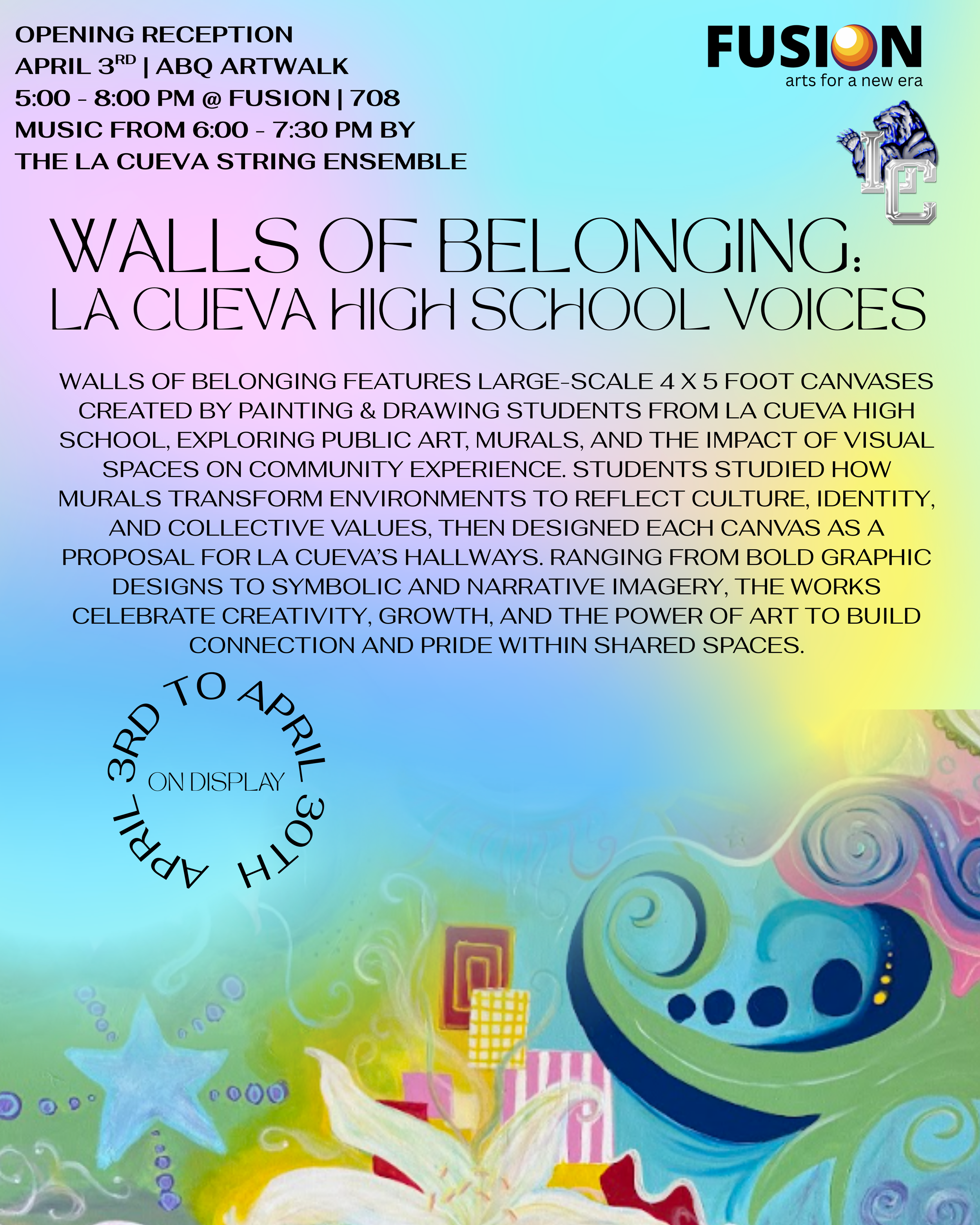
Such is the case with Walls of Belonging, a group exhibit of art students from La Cueva High School that opens at FUSION on Friday, April 3, at 5:00 PM.
These youthful denizens of the world of painting and drawing up at one of our town’s lauded learning environments—along with their equally and wonderfully creative faculty—were tasked with creating a world of connective, communicative walls, so to speak.
The press release for Walls of Belonging tells readers that this upcoming featured exhibition at FUSION features “large-scale 4 x 5 foot canvases” and showcases “an exploration of public art, murals, and the impact of visual spaces on community experience.”
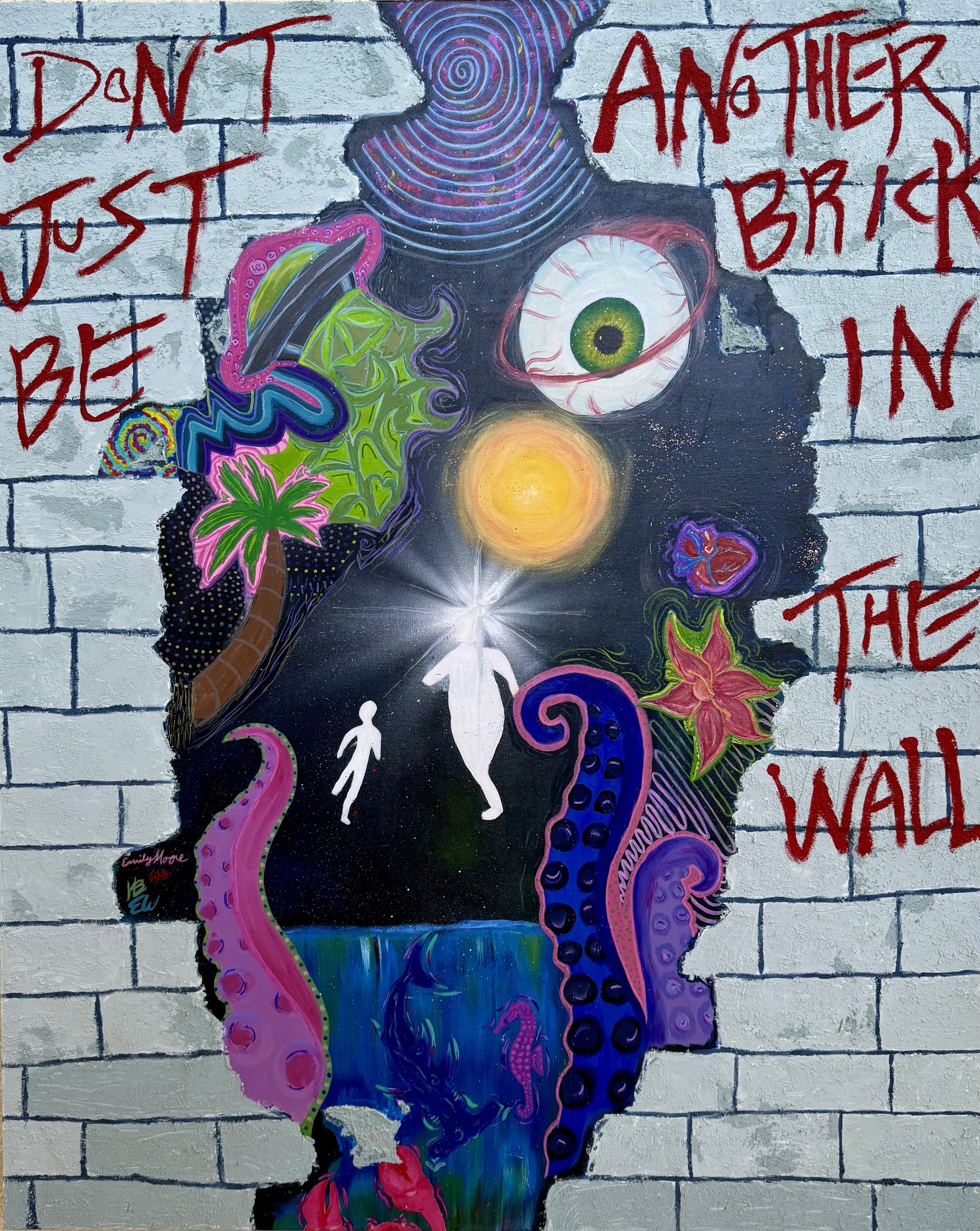
But the art created for this exhibit—and the creatives involved in its public and painterly manifestation—is much more than that. Each of the works in the exhibit speaks to the public in different ways, using a unique voice and personally curated materials. And each invokes the model I told you about earlier: here are works of art that speak directly to the public about that thing called the human experience.
I found that last part out when I spent some time talking to a group of young artists who were involved in making a large format painting (that’s what we called them in art school when Harry Nadler was in charge of painting stuff at UNM) for the soon to open exhibit.
My meeting with the artists of Walls of Belonging took place just before Spring Break took a hold of APS, so they were getting ready for some time off and were happy about the prospect. I reckoned that when they found out that I was on the other line of postmodern video connection taking place in their teacher’s office, they might have been put off, but instead I found that they were eager to talk about art, the public, and their growing identities as creative practitioners in Albuquerque.
Their main teacher in those matters, Mackenzie Farel, told me that some of the students from the exhibit were out in the studio, and she would call them over. That’s when Aspen Medley, Alexandra Field, and Aaron Lambert walked into the room and sat down to say hello. I started out my part of the conversation by asking Aspen to talk about their work for the show, which is entitled “The Window to Our Souls”. She recalled their artistic process when it began earlier in the semester, and told me, “We started at the very beginning of January when we got back from winter break. I’d say we chose different flowers that our group thought represented who we were as people. And we chose to orient them in a stained glass type of way, you know? Like, towards unity. And the flowers are surrounding this one big bird.”
Medley had me take a look at the large format painting/mural that the group had been studiously working on for the past few months. Then, she and the others started talking about the materials and techniques they employed in its creation. Alexandra Field was keen to point out that, “We used mostly just acrylic paint. We didn't start it off with anything like any white gesso on top. But we kind of wanted a watercolor appeal, but still using, you know, obviously acrylic, because acrylic goes better on canvas. So we, like, watered down the paint we used.” The result was a brightly transformative image of flowers signifying the triumph of the human soul.
As the conversation veered toward the subject of inspiration, Field told me that one of her big influences was Margot Robbie’s recent and very popular aspirational post-postmodern feminist film, Barbie. “I wanted to do flowers that represent each of us, because I’ve always liked flowers. In Barbie, the twelve dancing princesses all get a flower for their birthday. And I have been using that concept for a while in some different projects. I thought that it was a good idea to represent each other as flowers And then maybe, and have a bird to represent nature. And yeah, that’s awesome. I like that.”
Of course, that discussion eventually evolved into the expression of some important ideas about public art. Aaron Lambert nailed the whole thing together when he chimed in at that point, telling your reporter that, “They’re [the folks at La Cueva High School] like pointing at the walls, at the murals. They’re genuinely getting excited. They’re like, wow, that’s really cool. And I also relate to them because I go around, I see from class to class, I see different walls of murals. I’m so proud of our class and just our art program in general. We really have brought a lot of belonging to the school through this project. And I feel like it’s shown clear results.
Public art is not just like a concept. Adults and students, they’ve all expressed how it feels good to just see this art. It brings the community together. It’s an uplifting thing.”
At the end of the day, I was sure that Aaron Lambert and his cohorts at La Cueva were right. The idea of public art isn’t just a concept to be tossed about by academics or the establishment. Public art comes alive when whole communities, including students, teachers, and a grateful viewing public come together to create walls that bind us together instead of separating and confining us.
If you wanna get a better idea of just what I’ve been talking about in this short feature, make it part of your plan this week to check out Walls of Belonging at FUSION.
Opening of Walls Of Belonging: La Cueva High School Voices
Friday, April 3, 2026
5:00 –8:00 PM
FUSION | 708
708 1st Street NorthwestAlbuquerque, NM, 87102
After opening, this exhibit will be on view during public FUSION events or by appointment from April 3–30. To schedule a visit, Email FUSION.