

READING | SUNDAY, AUGUST 2 | 2 PM | FREE
El Palacio Summer Issue Reading and Q&A
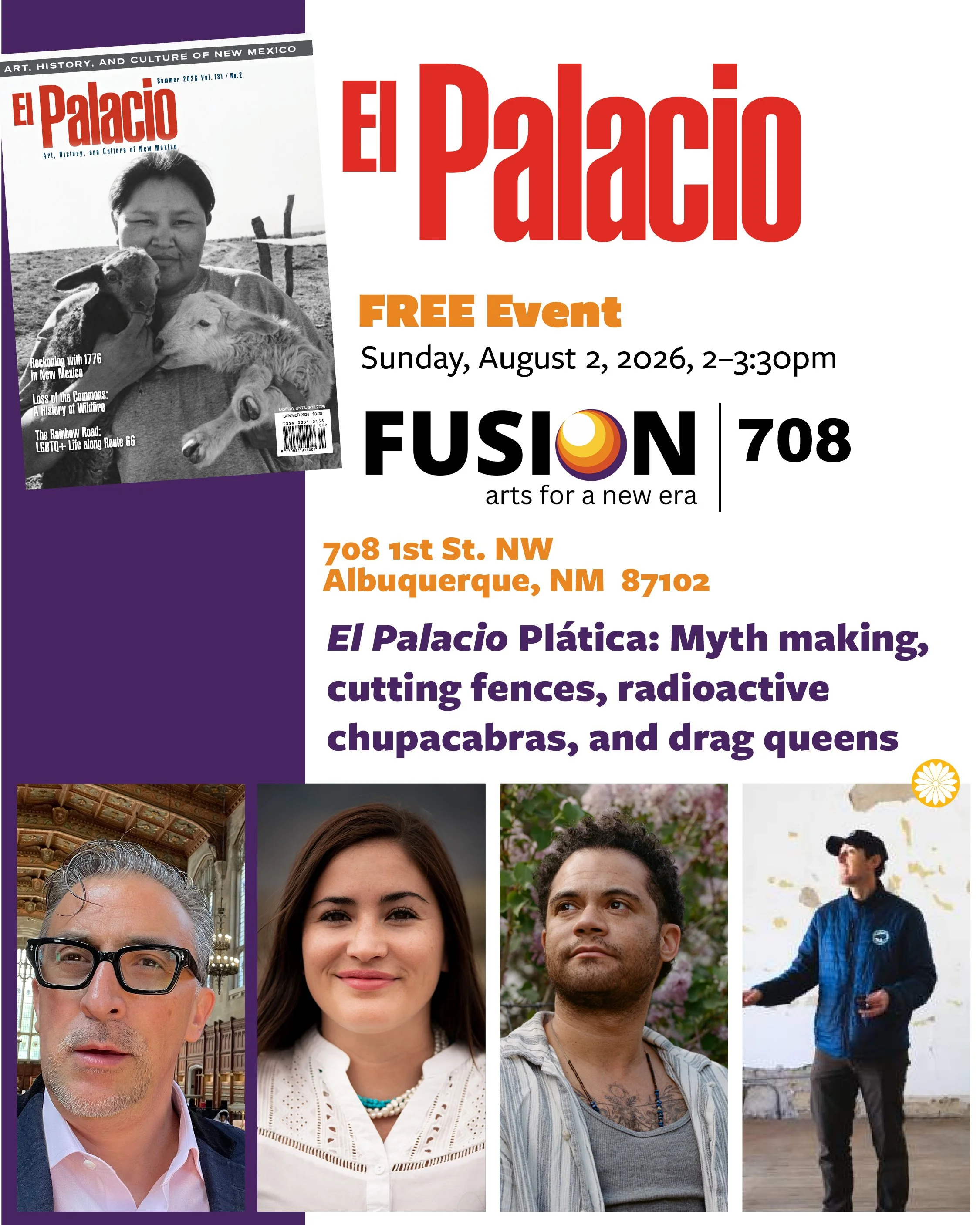
Join us for a panel and conversation with four featured authors from the summer issue of El Palacio magazine at FUSION | 708 on Sunday, August 2, at 2 PM.
Editor of El Palacio, Emily Withnall, and summer issue contributors Estevan Rael-Gálvez, Myrriah Gómez, Lazarus Letcher, and Oliver Horn will discuss New Mexico history—from Indigenous enslavement to Black and queer experiences on Route 66 to the loss of communal land grant land to the state’s nuclear legacy—and the nature of the archive. What do archives include and what do they exclude? How do we make sense of the past when our archives are incomplete—and how do we map our way forward? As the U.S. commemorates the 250th anniversary of the founding of the country, and the centennial of Route 66, El Palacio contributors will grapple with these questions and more. An audience Q&A will follow the discussion.
Copies of the Summer 2026 issue of El Palacio, featuring the panelists’ articles, will be available for sale. In addition, Page 1 Books will be selling Myrriah Gómez’s book, Nuclear Nuevo México, and other books that complement the themes in the summer issue.
ABOUT THE CONTRIBUTORS
Estevan Rael-Gálvez is President & CEO of Native Bound Unbound: Archive of Indigenous Slavery, and leads a global team to document Indigenous/Native slavery across the Western Hemisphere. He has formerly served as the senior vice president of Historic Sites at the National Trust for Historic Preservation, executive director of the National Hispanic Cultural Center, and the state historian of New Mexico.
Myrriah Gómez is an associate professor in the Honors College and Director of the Southwest Hispanic Research Institute at the University of New Mexico. She is author of Nuclear Nuevo México: Colonialism and the Effects of the Nuclear Industrial Complex on Nuevomexicanos.
Lazarus Letcher (they/them) is a PhD candidate in American Studies at the University of New Mexico. Their dissertation is titled Memorializing Queer and Trans Lives in a Time of Spectacular Erasure. They play viola for Eileen & the In-Betweens and Stages of Tectonic Blackness. Their writing can be found in Autostraddle, them, and the odd dry academic journal or fun zine.
Oliver Horn is the regional manager at Fort Stanton Historic Site and Lincoln Historic Site, part of the New Mexico Historic Sites division of New Mexico Department of Cultural Affairs. He also worked on the team that developed the 950-page Fort Stanton Historic Site Cultural Landscape Report, which serves as a roadmap for the site’s preservation.
ABOUT EL PALACIO MAGAZINE

El Palacio magazine is the oldest museum magazine of its kind, first published in 1913 by the Museum of New Mexico. El Palacio (“the palace”) refers to the first home of the Museum of New Mexico. Now reorganized under the New Mexico Department of Cultural Affairs (DCA), the quarterly magazine continues to cover the art, culture, and history of New Mexico and supports the exhibits, public programs, and scholarship of the department’s eight museums: the Museum of Indian Arts and Culture, the Museum of International Folk Art , the National Hispanic Cultural Center, the New Mexico Farm & Ranch Heritage Museum, the New Mexico History Museum, the New Mexico Museum of Art, the New Mexico Museum of Natural History and Science, and the New Mexico Museum of Space History; its eight state historic sites: Bosque Redondo Memorial at Fort Sumner, Coronado, Fort Selden, Fort Stanton, Jemez, Lincoln, Los Luceros, and Taylor-Mesilla; and its other divisions: New Mexico Arts, the New Mexico Historic Preservation Division, the New Mexico Office of Archaeological Studies, and the New Mexico State Library.
In addition to supporting DCA’s divisions, the magazine showcases the rich artistic traditions of writing, photography, and illustration that make up the fabric of New Mexico.
El Palacio —the name endures. Where it once recognized the magazine's first home, the magazine itself has become a royal residence, a “house eminently splendid,” for the story that is New Mexico.